
Sarah seated in a warm, sunlit workspace, wearing a burgundy blazer.
Neighbourhood evidence · Applied research

Neighbourhood Evidence Briefs for Better Planning

A scoped evidence brief for your community area and planning question, with maps, sources, methods and clearly stated limitations.

An exploratory, evidence-led service.

THE AQIMERYL APPROACH

What we do: Evidence that helps turn a question into a conversation

Community planning questions rarely have answers in a single dataset. Demographics, service locations, neighbourhood boundaries and local context each tell part of the story. We combine these public sources into focused, documented analysis your team can review, discuss and build on.

We help with questions such as:

  • Which neighbourhoods in our catchment have fewer mapped services nearby?
  • How does the population profile differ across neighbouring areas?
  • What evidence is missing before we plan?
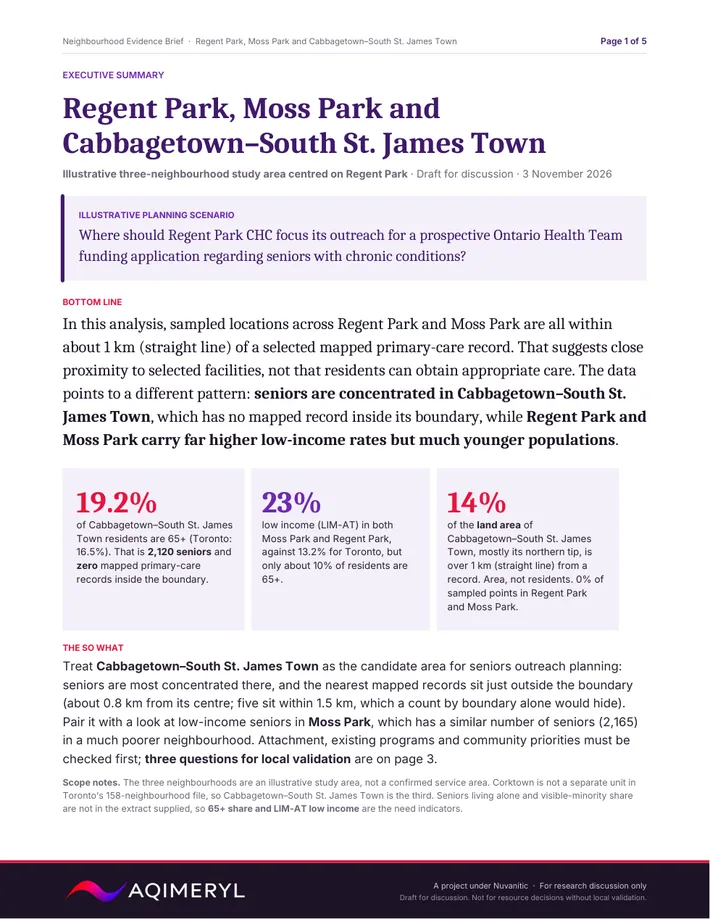
Illustrative evidence report

Neighbourhood Evidence Brief: A written document, not another dashboard

A brief covers one catchment and one question. It includes a catchment overview, a review of mapped service locations, two or three areas for closer review, the evidence gaps and next steps, and a shareable report.

One catchment. One question. One shareable report.

  • Catchment overview and documented population indicators
  • Review of mapped service locations and what they do not measure
  • Two or three areas for closer review with local partners
  • Evidence gaps, next steps and source references

If the evidence cannot support your question, we will say so before work begins and adjust the scope or decline.

A straightforward process

Four steps, with the limitations visible.

01

Agree on the question

Choose the catchment, the decision to support, and what a useful output looks like.

02

Check the evidence

Review public or authorized datasets, limitations, coverage and dates.

03

Prepare the brief

Compare local patterns, document assumptions and flag questions that need confirmation.

04

Review together

Walk through the findings and agree which additional evidence would be worth obtaining.

Census indicatorsAge · Population · Income
Healthcare recordsMapped service categories
NeighbourhoodsToronto · 158 areas
AQIMERYLNeighbourhood Evidence BriefTimeline agreed after scoping
A clear planning documentMaps, evidence gaps, and next steps
01

See communities in context

Compare mapped service records with neighbourhood demographics.

02

Spot areas for closer review

Identify places and questions for local follow-up—not a claim of healthcare shortage.

03

Support coordinated planning

Share a written document for internal discussion or funding applications.

Illustrative process. The findings in each brief depend on data availability, permissions, and local validation.

Explore the work

Explore the work

Review a six-page illustrative brief and the Toronto Healthcare Explorer to see the kinds of questions public data can address. These are examples, not commissioned reports, and not substitutes for locally validated service-capacity or utilization data. Regent Park Community Health Centre did not commission or endorse the sample.

Explore Toronto Neighbourhood ↗

Evidence before conclusions

The Explorer supports the analysis. The brief is the deliverable.

Our Toronto Healthcare Explorer maps selected service records against 2021 census indicators across 158 neighbourhoods. It helps explore patterns; it cannot establish healthcare access or shortages on its own. AQIMERYL is organizing the underlying public sources, geographic references and analytical outputs within a developing internal repository called ANER — AQIMERYL Neighbourhood Evidence Repository. ANER is not a proprietary census or a fully validated database; individual source dates and calculations still require verification.

Exploratory tools are not clinical guidance and should not determine resource allocation without further evidence and appropriate local review.

The Data Story

Beyond the map: the stories behind local evidence.

Explore how communities can interpret neighbourhood data and turn observations into better planning conversations.

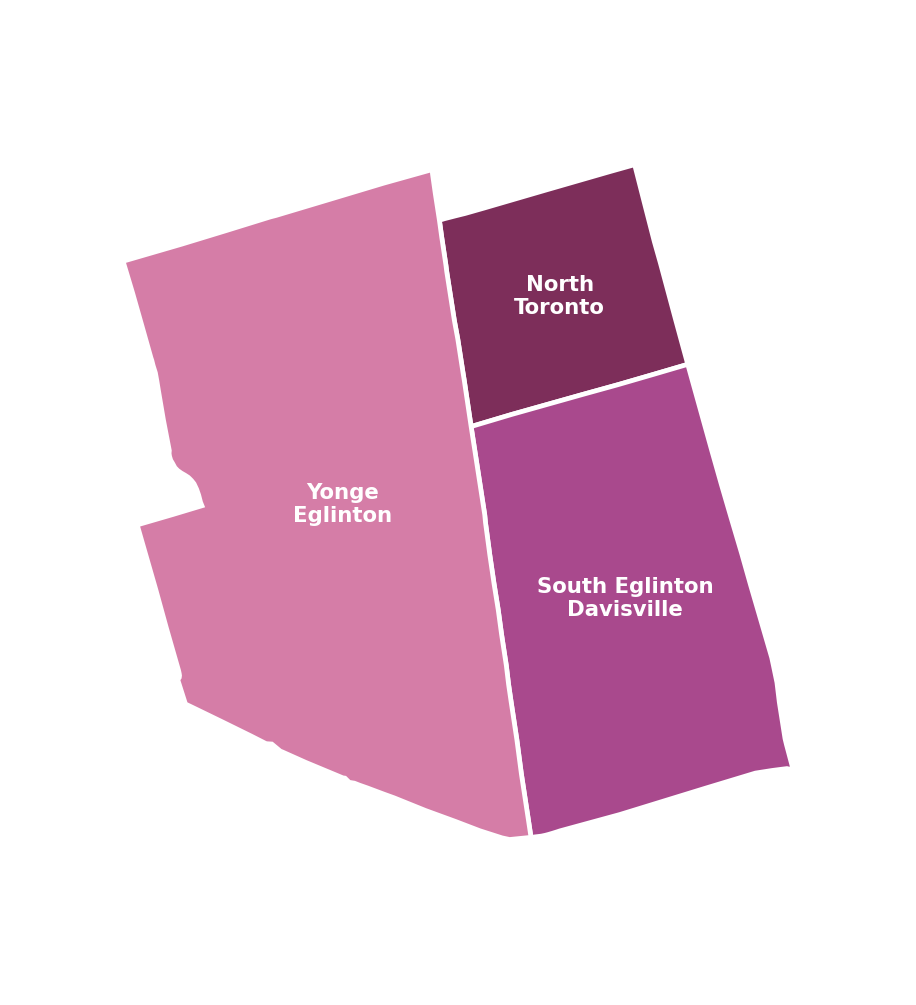
Illustrative neighbourhood mapping graphic, not an Evanston map
Featured research story

Beyond the Map: How Evanston Turned Neighbourhood Data into Community Conversations

What a documented Illinois example reveals about interpreting local evidence with residents and planning partners.

Read the story → · All stories

The Data Story · Community Health Planning

Reading Neighbourhood Data Carefully: What Evanston Shows Toronto Community Organizations

Citywide averages can hide the differences that matter most for planning. Here is what one Illinois example shows, and what it cannot tell us about Toronto.

Read the data carefully →

About AQIMERYL

Clear questions. Useful documents.

AQIMERYL is an applied research initiative focused on advancing how neighbourhood evidence informs community health planning.

We develop reproducible methods and evidence-based tools that bring together public data, geographic analysis, and community-level indicators to support more informed planning decisions.

Our initial work draws on Toronto neighbourhood datasets and Ontario healthcare service-location information, with methods and data sources assessed for each proposed planning question.

The Neighbourhood Evidence Brief is an early-stage service under development. We make no claims of completed client engagements or measured outcomes.

Our Data & Sources

AQIMERYL draws on publicly available Canadian information, including Statistics Canada census indicators, City of Toronto geographic datasets and selected Ontario service-location records.

We organize these sources through our developing AQIMERYL Neighbourhood Evidence Repository (ANER) to support documented methods and consistent geographic comparisons. ANER is under development; source quality, coverage, reference dates and individual calculations require verification.

Statistics CanadaCity of TorontoOntario government data
Questions

Questions before getting started

Is this a healthcare access assessment?

It is an exploratory planning brief. It cannot establish unmet medical need or care availability from mapped facility records alone.

How do I request a brief?

Use the online Evidence Brief intake form to describe your area and planning question. We review feasibility and can clarify details by email before providing a written quote; a discovery call is not required.

Can you use patient or protected health data?

Not through the website. Any sensitive information would require separate permissions, safeguards, and a suitable agreement. Do not submit patient details using the form.

Do we need to buy a dashboard?

No. The proposed deliverable is a written briefing document. The public prototype simply illustrates the mapping approach.

Start a conversation

What neighbourhood question would help your team?

Tell us the area and the planning question. We’ll discuss what public data can show, what needs local validation and whether a brief would help. There is no cost to inquire. Please don’t send personal health information or patient records.

Request an Evidence Brief →

Please do not send personal health information, patient records, or sensitive data. We use contact details to respond to inquiries.

By submitting this form, you provide contact and project information for us to review and respond to your inquiry. Read our privacy policy. Please do not include personal health information or patient records.